
Case Study — Content Standards and AI
Standards That Outlast the Team
Northbeam · Reconstruction · Fictional Brand
I authored the first content design guidelines on Floor and led global content standards creation with Storefront, elevating content design to the same hierarchical level as product design, and built a 94-criteria evaluator to sustain standards when content design was cut.
The Challenge
Associate-facing teams and consumer-facing teams were writing without a shared global content design standard. Alerts, modals, text fields, and toasts behaved differently by team. Chat bots had no single standard, which created legal risk. Engineering paid for the drift in rework and tech debt.
The gap wasn't only punctuation. It was how content could behave consistently and clearly inside the components we used to build our products, as well as where this content design guidance lived in the information architecture of the design system doc site.
Two systems had to come together: Storefront (consumer) and Floor (associate) into one design system. I owned Floor Design System content, building the first content style and component-level content guidance. Now, working closely across the enterprise with Storefront content designers through review and collaboration, I was tasked with building global content design standards.
Then the UX organization and content design function were eliminated. The newly-built global content design standards were orphaned, left without an owner. Teams without content designers were still shipping UI and needed ways to align content standards.
The Approach
The Merge
Building on the success of Floor, I led content design efforts to bring Storefront and Floor Design Systems into one unified design system, introducing the company's first global content design standards. Working collaboratively across the enterprise, I aligned style, patterns, and component language across the organization. The idea of having two separate content standards was killed—that was the original drift.
Parity
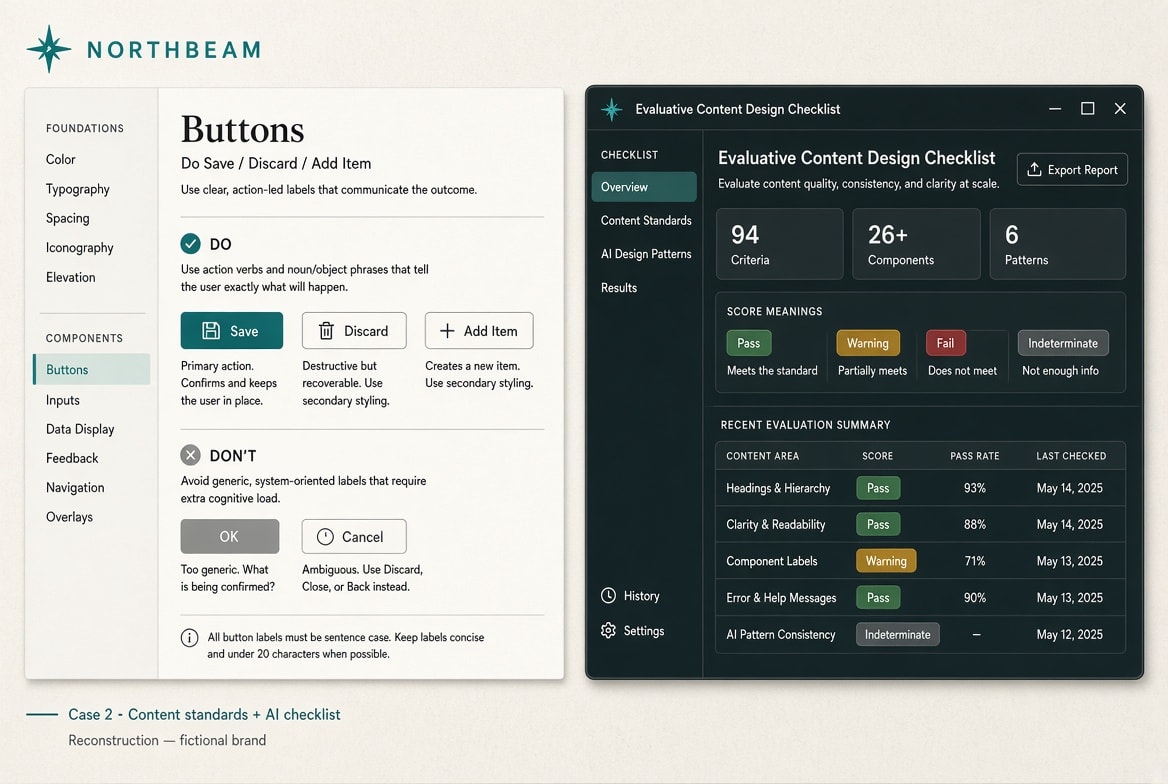
I elevated UX content to full parity with product design by locating content design for components and patterns at the same hierarchical tab level as product design on the design system doc site.
Enforcement After the Cut
After content design ceased to be a function at the company, I came to the aid of product teams shipping Ui by building the first AI-driven Evaluative Content Design Checklist to help align and guide global content standards. I authored 94 content design criteria, prompted the model and built the tool.
Content standards reflected in the tool covered word usage and how content behaves in our components: button labels name the action (verb + noun); one action per button; title case on buttons and labels; sentence case on body, helper text, errors, and badges; alerts inform and recover; they don't alarm.
From Mechanics to the System
The first work was mechanical: labels, alerts, how buttons behave. The later work was the system: one standard across Storefront and Floor, content design at the same information-architecture tab as product design, and a 94-criteria evaluator I authored and built so a model could score UI I would never see. I used the model for volume—Pass, Warning, Fail, rewrite. I kept the judgment the model cannot make: Indeterminate means the screenshot can't prove the claim: That gate is the job. The checklist scores real UI against the global standard: error messages and alerts; clear language; capitalization and punctuation; component-specific content behavior; voice and tone; accessibility and inclusion; research and testing; content business strategy.
Each item returns Pass, Warning, Fail, or Indeterminate. Indeterminate means the screenshot cannot prove the claim (alt text, research, KPIs); again, by design, the tool doesn't fake a pass. It also returns a rewrite.
"Multiple model numbers are associated to this item number. Scan item barcode to add item to cart."
→ "This item has multiple model numbers. Scan the barcode to add it to your cart."
Item Entry
→ Add Item. Same pattern: Customer Lookup → Look Up Customer.
A run on raw system-exception copy scored 3 pass / 18 warning / 57 fail / 25 indeterminate.
The Result
One design system and global content standard, with content design at the same tab level as product design, and one source of evaluative content truth in Figma for Storefront and Floor designers and product managers.
This created a workflow product teams could run before launch after content design was no longer staffed across the organization. The evaluator isn't the case: The case is that content design moved from writing strings on Floor to governing language across the system—and still ran after the function was gone because the gates were written down, and the model was not allowed to invent a pass.